EuroGuiDerm Acne Treatment Guidelines 2025:
Key Updates Every Dermatologist Should Know
The 2025 EuroGuiDerm acne guideline is a targeted update of the 2016 edition. It brings clinically significant changes across ten areas: from when to start isotretinoin to the first-ever inclusion of spironolactone, from antibiotic caps to new topical agents and a formal clearance of BPO safety concerns. Here is a complete, evidence-referenced breakdown of every key change.
📌 Table of Contents
- Isotretinoin Recommended Earlier and More Decisively
- Systemic Antibiotics Capped at 3 Months
- Azithromycin Discouraged — Except in Pregnancy
- Spironolactone Added for the First Time
- Trifarotene Formally Positioned for Truncal Acne
- Clascoterone (Winlevi) Approved — Not Yet in Algorithm
- BPO Officially Cleared of Cancer Concerns
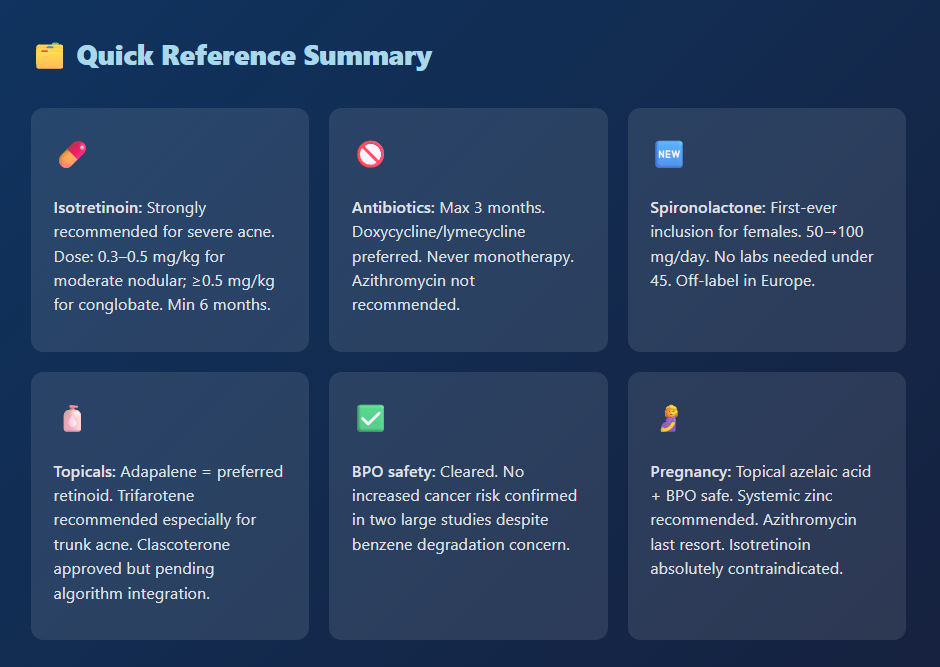
- Isotretinoin Dosing Now Formally Defined
- Pregnancy Treatment Protocol Clarified
- Contraceptive Generation Now Matters for Acne
Isotretinoin Recommended Earlier and More Decisively
Systemic isotretinoin now holds the highest strength of recommendation (“strongly recommended”) for two acne types:
- Severe papulopustular / moderate nodular acne
- Severe nodular / conglobate acne
This represents a clearer and more decisive push toward isotretinoin over prolonged antibiotic courses in these groups, compared to the more cautious 2016 language.
Use our Isotretinoin Dosage Calculator to work out the correct starting and cumulative dose once isotretinoin is chosen.
Systemic Antibiotics Capped at 3 Months
For the first time, a definitive 3-month maximum duration is established for systemic antibiotic treatment of acne — with 100% consensus from the guideline group.
| Scenario | Recommendation |
|---|---|
| Standard use | Limit to 3 months |
| Extension beyond 3 months | Exceptional only — when isotretinoin & hormonal therapy are unsuitable |
| Preferred antibiotics | Doxycycline and lymecycline over minocycline and tetracycline |
| Monotherapy with antibiotics | Not recommended — always combine with a topical agent |
Azithromycin Discouraged — Except in Pregnancy
Based on an EMA recommendation published during guideline development, azithromycin is no longer included in the standard acne treatment algorithm. Current evidence does not sufficiently support its efficacy, and resistance risks are considered to outweigh benefits.
| Context | Status |
|---|---|
| General acne population | Not recommended — EMA directive |
| During pregnancy | Last resort only — careful risk-benefit assessment required |
The pregnancy exception exists because azithromycin remains the only available systemic option when isotretinoin, doxycycline, and lymecycline are all contraindicated.
Spironolactone Added to the Guideline for the First Time
Despite being off-label for acne in Europe, spironolactone is newly included in the guideline as an adjunctive systemic option for female patients — driven by accumulating evidence of efficacy.
- Indicated for: papulopustular, nodular, or conglobate acne in females
- Particularly beneficial in acne associated with PCOS or androgen excess
- Used as an adjunct to standard therapies, not as monotherapy
Trifarotene Formally Positioned for Truncal Acne
Trifarotene (a 4th-generation RAR-γ selective retinoid) is now formally included with a medium strength of recommendation, making it the first topical retinoid with robust evidence specifically for truncal acne.
- Effective for both facial and trunk/body acne
- Recommended as a combination partner with systemic antibiotics in moderate-to-severe disease
- Important limitation: No head-to-head trials against adapalene yet — so adapalene remains the preferred topical retinoid in most situations
Clascoterone (Winlevi) Approved — Not Yet in Algorithm
Clascoterone — a topical androgen receptor antagonist — received EU marketing authorization in October 2025, approved for:
- Adults with acne vulgaris
- Adolescents aged 12 to <18 years (facial acne)
However, because it was not yet approved at the time of the consensus conference and clinical experience was lacking, the guideline group decided not to integrate it into the treatment algorithm in this edition. It is expected to appear in future updates.
BPO Officially Cleared of Cancer Concerns
Concerns arose from reports that some OTC BPO products can degrade into benzene — a known carcinogen — at high temperatures (37–70°C). The guideline formally addressed this and reviewed the evidence:
- One large study found no higher prevalence of AML among BPO users
- Another found no increased risk of lymphoma, leukaemia, or internal cancers compared to matched controls
Isotretinoin Dosing Now Formally Defined
For the first time, the guideline provides explicit consensus-based dosing recommendations for systemic isotretinoin:
| Acne Type | Recommended Dose |
|---|---|
| Severe papulopustular / moderate nodular | 0.3–0.5 mg/kg/day |
| Severe nodular / conglobate | ≥0.5 mg/kg/day |
| Refractory / poor response | Up to 1 mg/kg/day |
| Minimum treatment duration | 6 months (can be extended if insufficient response) |
| Clearance criteria | Patient should be clear of inflammatory lesions for at least 1–2 months before stopping |
Calculate exact daily and cumulative doses instantly with our Isotretinoin Dosage Calculator.
Pregnancy Treatment Protocol Clarified
The guideline provides a clear, consensus-backed framework for managing acne during pregnancy:
| Route | Permitted Options |
|---|---|
| Topical | Azelaic acid ✅ BPO ✅ Clindamycin (with BPO) ✅ Erythromycin (topical) ✅ |
| Systemic | Zinc ✅ Azithromycin ⚠️ (last resort only — careful risk-benefit assessment) |
| Isotretinoin | Absolutely contraindicated — high teratogenic risk. Effective contraception is mandatory. |
Systemic corticosteroids can be considered in cases of conglobate acne with very strong inflammation, high pain levels, systemic symptoms, or fulminant progression.
Contraceptive Generation Now Matters for Acne
The guideline now formally classifies combined oral contraceptives (COCs) based on their expected impact on acne — a critical clinical consideration for female patients:
| Contraceptive Type | Acne Impact |
|---|---|
| Co-cyprindiol (EE + cyproterone acetate) | Beneficial — antiandrogenic |
| 3rd / 4th generation progestins (desogestrel, dienogest, drospirenone) | Less likely to worsen / possibly beneficial |
| 1st / 2nd generation progestins (levonorgestrel, norethisterone) | May worsen acne — androgenic effects |
| Non-oral: etonogestrel implant, norgestromin patch, levonorgestrel IUD, vaginal ring | May worsen acne |
This post summarizes a published clinical guideline for educational purposes. It does not constitute medical advice. Always refer to the original publication and apply clinical judgment to individual patients.
Subscribe to our newsletter!
#acne guidelines #acne guidelines 2026